My story is drawing to a close — my loyal comrade and sarcastic joker Rybakov is leaving me. He is rushing off to Latvia for Stipro Skrējiens — a race for people who find climbing 2km up mountains insufficient; they also need to flounder in freezing spring mud, break their limbs on slime-covered wooden obstacles, and endure all sorts of other humiliations and abuses just so life doesn't seem boring. In my own way, I get bored too, but not quite to that extent, so I still have a couple of days left to discover the outskirts of Larnaca.
Rybakov flew out early in the morning, while I leisurely rolled into the center to hit up the bike shop and pick up the spare parts from my rim repair on day one. I was in for a letdown — the shop was closed, despite it being a Friday. I asked the first Cypriot I came across what the deal was, and he replied, "Bank holiday." For those who haven't rubbed elbows with the British, this expression might seem puzzling — what do banks have to do with shops being closed? Fortunately, I'm a man of the world (insert solemn throat-clearing here) and therefore aware that it's just the traditional British term for a public holiday (for the history buffs, it's simple — primarily, the Bank of England would close on certain days).
And the reason this Cypriot grandpa answered me with an English idiom is that Cyprus's ties with the British Empire run deep, and it only recently got out from under it.
But what kind of public holiday is this right in the middle of spring? Boom! Boom! The drumbeats all around triggered an epiphany in my brain, exhausted by the heat and the endless elevation gains. Today is May First, Labor Day!
Down the main avenue, and then along the exceedingly long promenade, stomps a ceremonial procession of schoolchildren, young men and women in uniforms. I've never seen so many percussion instruments in my entire life — it seems they had to scour the whole of Cyprus to arm everyone. Uniforms of all colors — green, white, red, and among them a ton of flags with a clenched fist, looks like the trade union movement or its various offshoots.

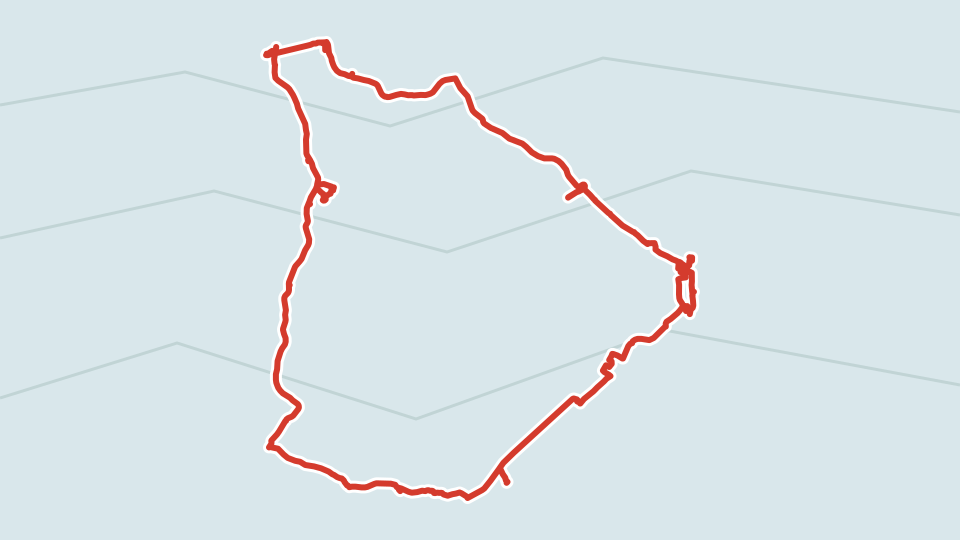
After gawking at the parade for a bit, I finally decided to go all in and ride the road route of the CTO you already know, which was close to a hundred kilometers long. Too late to ask myself why I need this — the course is set, the landmarks are in sight, it's time for action.

Having stocked up on water properly (who knows what lies ahead on the way), I moved in a triangle around the windmills, which you will see from many angles in my photos.
Endless wheat fields glowing with gold awaited me on the route. I haven't seen so much wheat in my entire life — though I suspect I just haven't had the chance to visit the parts of Ukraine that are the breadbasket.
A warm but very strong headwind blew in my face, creating a gentle sensation that it is the height of summer right now, yet not letting me forget that I am, after all, near the sea.
There was a ton of older cyclists on sick road bikes in full cycling gear. If I wanted to, I probably could have even caught up with them, we were barely doing 25, but I didn't want to go too hard — I still had another kilometer of elevation gain ahead, and 90 km of distance.

In these parts, the vegetation is much livelier, apparently they water it properly. The result is delightful — smells delicious, looks great.

If you can't tell an ancient church from a modern one, and what the value of an architectural monument is, is it even worth studying them? I used to stress out a lot about not knowing something, but now I think it's impossible to know everything, and what's the difference anyway — having a broad outlook is nice and useful, but as with everything, it's best to do it without fanaticism.


Windmills against the backdrop of wheat

Hills against the backdrop of mountains

Wheat against the backdrop of wheat

The Tin Woodman against the backdrop of ads

This part of Cyprus is full of these mini-hills. I climbed one or two of them, but it's boring and unnecessary — there's usually nothing there, except for an extra two hundred meters.

And rocks, occasionally covered in trees


A protected monument of antiquity, by the way. I'd tear it down without a second thought

The most worthy sign on the route


In places, it totally looks like my home turf, especially if you imagine that it's been a hot and dry summer

These kinds of roads are more to my liking than asphalt, but I just didn't have the energy for planning and navigation anymore


I rolled into the excavation site by bypassing the padlocked museum through someone's vegetable garden. Us tourists, we're such cheeky bastards, totally uncivilized — if something looks interesting, we just barge right in


An unprecedented trace of civilization in the middle of the villages

Some of the wheat has already been harvested

And some hasn't yet

The most boring hills in the world, but interesting to see once

Windmills from the other side


I rode over a hundred kilometers solo that day. There are people who feel comfortable and at peace in solitude, but the longer I live, the more I realize that man is a social creature, and I'm probably more social than most. The division into introverts and extroverts, like all social constructs, is contrived. If I have something to do, I have a pretty good time alone too — like right now, for instance, writing in this clunky (as one visitor called it) blog, or when I'm working thoughtfully and totally immersed in the process. But such immersion, also known as flow, comes easily to calm people. For those who are emotionally more restless, the easiest thing to dive into is a conversation or a shared game, because we humans are hardwired for it, even if you're the most introverted introvert on earth.
I will travel alone too, if it can't be helped, and that way is good as well — it pushes you to step out of your comfort zone and interact with the locals. Ultimately, we now live in a global village, and by hacking a local telecom operator's leaky Wi-Fi, you can call friends in Latvia from any village. But after living a decade or two, you start appreciating something more physical and real — live human interaction, the surrounding landscapes, the smell of the forest and fields. A human being has too many senses, and they are too complexly wired for us to be satisfied with the currently existing virtual toys.
The world is infinite, unknowable, complex, and beautiful.